
Here’s a question that sounds easy. How much did you sell yesterday?
Most teams look at the bank. A deposit came in from the processor. That’s the number.
It isn’t. And this one mistake is behind a surprising amount of month-end pain.
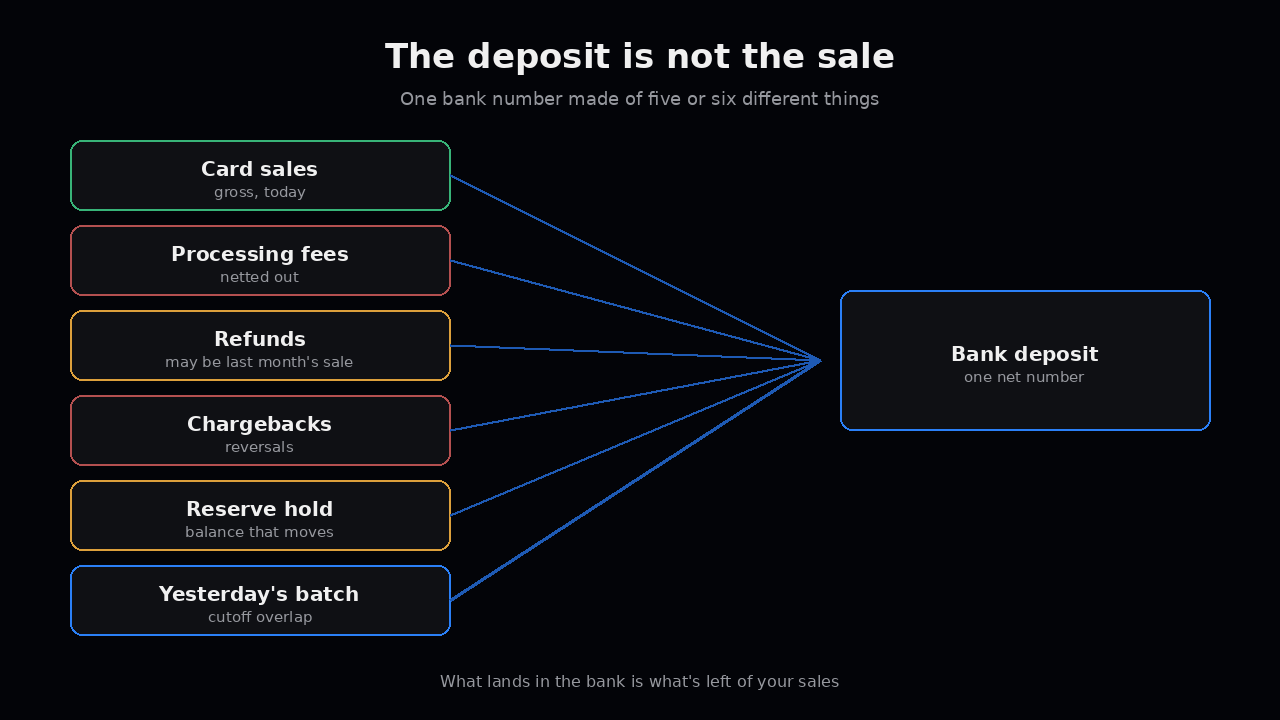
What the deposit actually is

A processor doesn’t send you your sales. It sends you what’s left of them.
Take a day’s card sales. Subtract the processing fees. Subtract refunds that happened that day, even if the original sale was last month. Subtract any chargebacks. Hold back a reserve if your account has one. Then bundle it with part of yesterday’s batch, because cutoff times don’t line up with your day.
What lands in the bank is one number made of five or six different things. Some belong to today. Some belong to last week.
Why booking the deposit breaks things

If you record the deposit as revenue, three things go wrong.
First, revenue is understated, because the fees got silently netted out. You can’t see what payments actually cost you.
Second, refunds land in the wrong period. A refund for a March sale shows up as lower April revenue.
Third, nothing ties out. Your sales system says one thing, the bank says another, and someone spends Friday afternoon in a spreadsheet trying to explain the gap.
We’ve seen teams carry an “unexplained difference” line for months. It’s almost never fraud. It’s almost always netting.
Book the pieces, not the total

The fix is boring, which is a good sign.
Every sale is its own record, with your own id, at the gross amount. Every fee is its own record. Every refund and chargeback is its own record, tied back to the sale it reverses. A reserve hold is a balance that moves, not money that vanished.
Then the deposit is just a check. Gross sales minus fees minus refunds minus reserve should equal what hit the bank. When it does, you’re done. When it doesn’t, you know exactly which piece is off.
Most processors already give you a settlement report that breaks this down. The work is reading it into your ledger line by line, instead of reading the bank total and moving on.
The small test

Pick one deposit from last week. Try to list every sale, fee, and refund inside it.
If you can do it in five minutes, your books are in good shape. If you can’t, the deposit is doing your accounting for you, and it’s doing it badly.