.png)
Most of the work in payments isn’t moving the money. It’s everything that has to happen when a transfer doesn’t go the way it was supposed to.
A payments platform we worked with had an instant bank transfer product that worked. That’s the thing people forget. It wasn’t broken. It processed transfers, customers used it, money arrived. The problem was that it only worked if a few people paid attention to it every day.
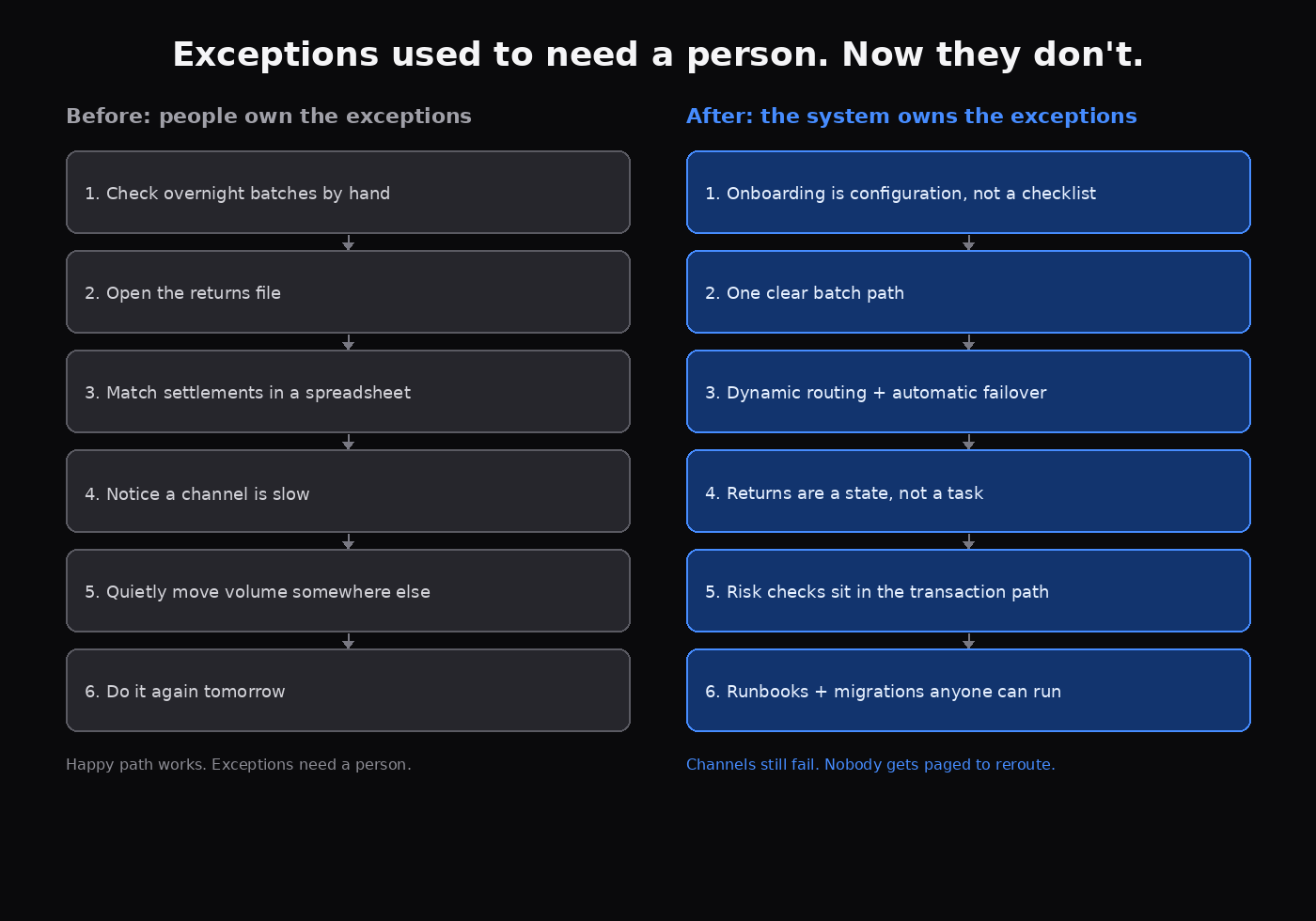
Those people had a routine. Check the overnight batches. Open the returns file. Match things up by hand. Notice that one settlement channel was slow again and quietly move volume somewhere else. Then do it again tomorrow.
None of that is in the product spec. It’s the part that grows quietly until you can’t add a new client without adding a person.
Why this matters more than it sounds
A payment rail is a system where the rare cases are the expensive ones. Most transfers are boring. The rest — returns, reversals, a channel having a bad morning, a duplicate, something that looks like fraud — is where the cost lives.
If your architecture treats the happy path as the product and the exceptions as something humans handle, you’ve built a business that scales by hiring. That works for a while. Then a partner asks how fast you can onboard their next program, and the honest answer is “as fast as we can train someone.”
So the goal wasn’t speed in the usual sense. It was making the exceptions boring too.
Rebuilding the core, end to end
We re-architected the instant bank transfer product rather than patching around it. Onboarding became automated instead of a checklist someone works through. Batch processing got streamlined so it’s one clear path instead of several that grew at different times for different reasons.
The point of that work is time-to-market. When a new program can be configured rather than built, the gap between “yes we’ll do it” and “it’s live” stops being a quarter.
Routing that doesn’t need a person watching it
Settlement channels have bad days. That’s normal. What isn’t normal is finding out because a customer complained, or because someone happened to be looking at the right dashboard.
We built dynamic routing with automatic failover across channels. If one path degrades, transactions move to another without anyone deciding to move them. Nobody gets paged at 6am to reroute by hand.
To be clear about what that is and isn’t: it’s resilience, not a promise that nothing ever fails. Channels still have outages. The system just stops treating an outage as an emergency that needs a human in the loop.
The returns pipeline
This is the unglamorous one, and it’s probably the one that mattered most.
We built proper batch handling for ACH and clearinghouse returns, status reconciliation, and representment. Before, a return was an event that produced a task for someone. After, it’s a state the system knows how to be in.
Reconciliation is the same story. Matching what you think happened against what actually happened is a task computers are good at and humans are bad at — not because humans are dumb, but because it’s repetitive, high-volume, and gets less accurate the more tired you are.
Risk controls in the transaction path, not beside it
Blocklist and risk-management data pipelines went into the core transaction lifecycle. Not a nightly job, not a report someone reads on Monday. In the flow, near real-time, so a suspicious pattern gets stopped while it’s happening rather than documented after.
Putting risk checks in the hot path means they have to be fast and they have to scale, which is why this was an architecture decision and not a feature.
Making it repeatable
Then the part nobody blogs about. Runbooks written down instead of living in people’s heads. Database migrations with an automated strategy rather than a careful evening. Configuration services standardized across regions so environments actually match.
This is what operational maturity means in practice. It’s the difference between a system that one team can run and a system that any competent on-call engineer can run.
What it looks like when it works
Mostly, it looks like nothing.
The returns file gets processed and nobody opens it. A channel degrades at 3am and the routing handles it and you read about it in the morning log. A new program goes live in days because onboarding is a configuration, not a project. The daily checklist shrinks until it isn’t a checklist.
Good payment infrastructure is infrastructure you stop thinking about. That’s the whole goal.
What we do and what stays yours
Futurify builds software. We don’t hold funds, move money, or act as a payment processor. Your provider agreements, licenses, and regulatory obligations stay yours. We build the engineering underneath.
Next step
If you’re running payment rails and the exceptions are eating your team, email hello@futurify.io. Happy to talk about how yours is put together.