.png)
Every payments team has one. Most call them breaks — and then don’t look at them again until Friday.
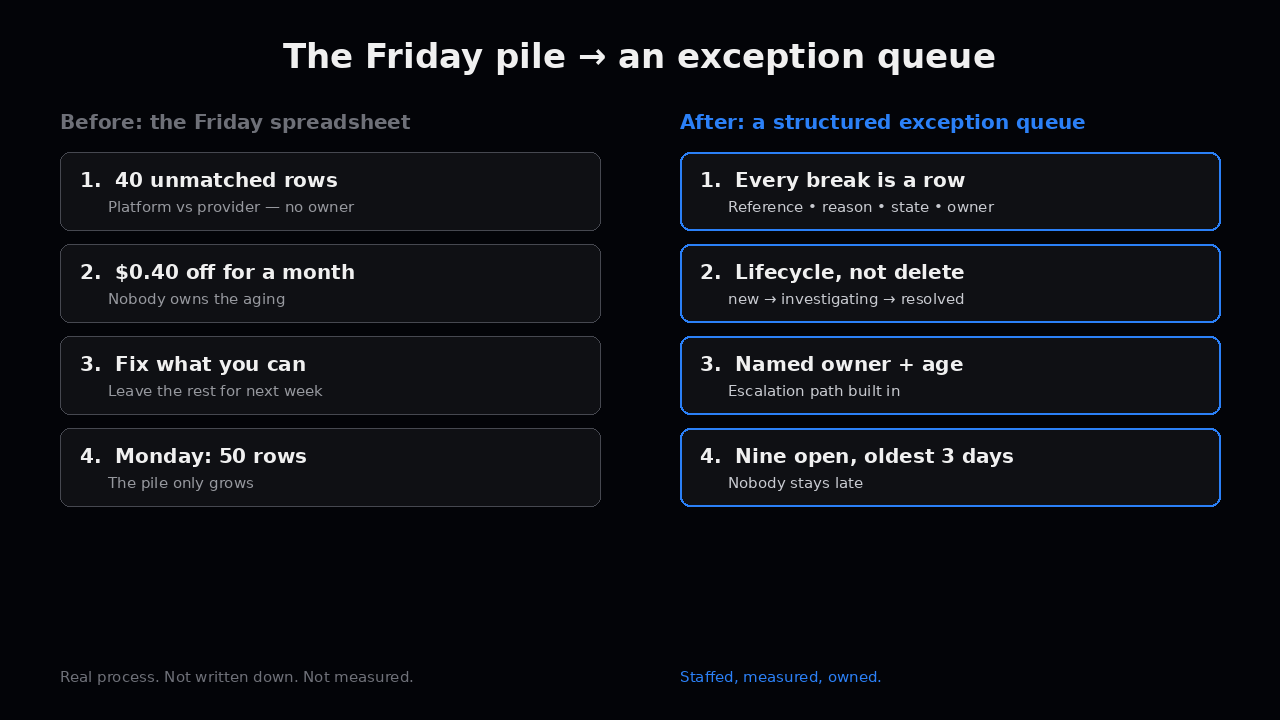
Friday afternoon, someone opens a spreadsheet. On one side, what the platform thinks happened. On the other, what the provider says happened. In between, forty rows that don’t agree.
A payout went out twice. A refund landed on a different day than the capture. Three returns came back with a code nobody has mapped. One amount is off by $0.40 and has been for a month. Someone fixes what they can and leaves the rest for next week. By Monday there are fifty rows.
That spreadsheet is a real operational process. It’s just not written down, not measured, and not owned by anyone except the person who happens to be good at it.
Why Friday
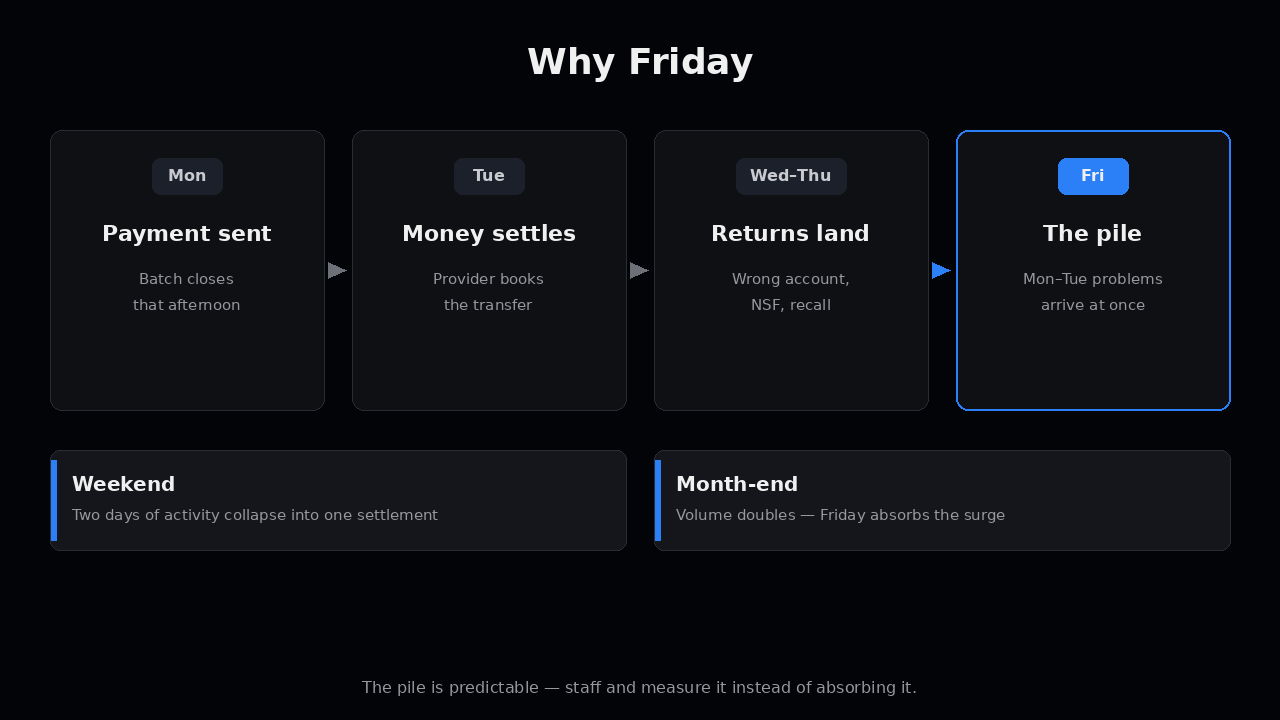
It isn’t superstition, it’s the calendar.
A payment you send on Monday doesn’t finish on Monday. The batch closes that afternoon and the money settles the next day. And if that payment is going to fail — wrong account, not enough money, a return — the bank usually doesn’t tell you until two or three days after that.
So the problems landing on your desk on Friday mostly aren’t Friday’s payments. Friday’s payments haven’t finished yet. What you’re looking at is Monday and Tuesday, only now reporting back.
Add the weekend, which pushes two days of activity into one settlement, and month-end, which doubles everything. Friday is simply when it all arrives at once.
So the pile is predictable. Which means it can be staffed and measured instead of absorbed.
Match properly before you triage
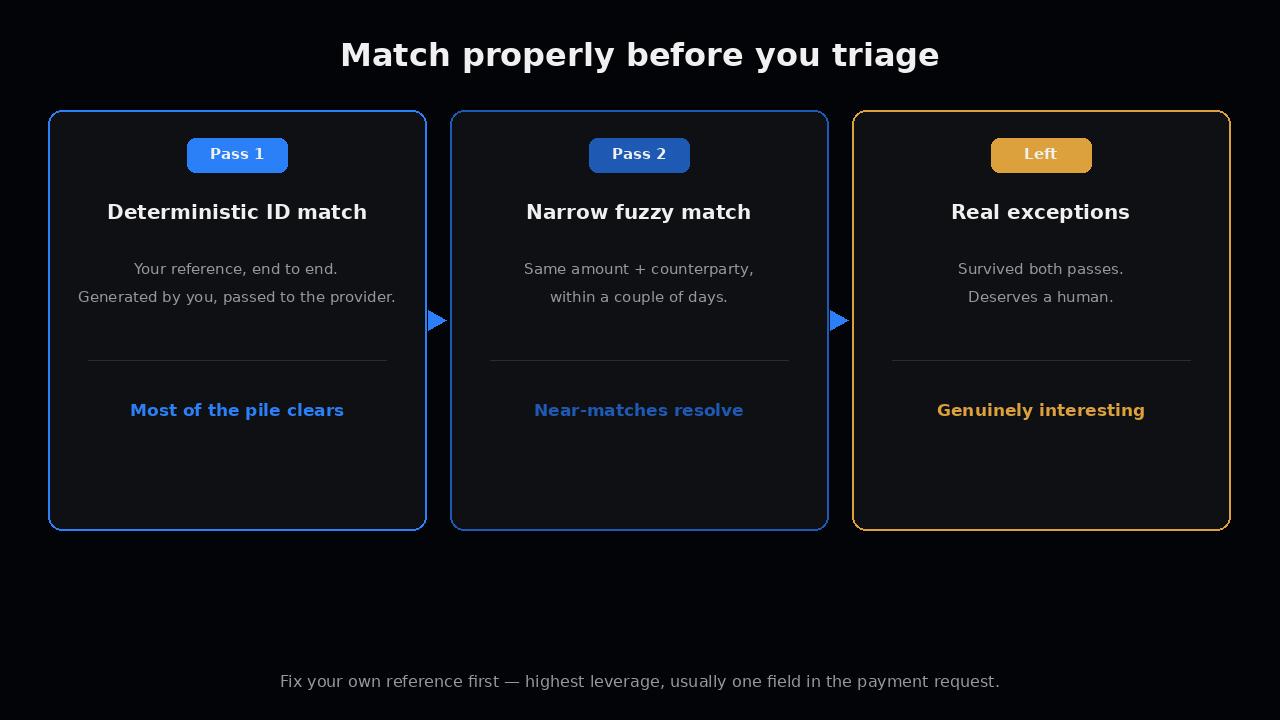
If your own reference doesn’t survive the round trip, fix that before anything else — it’s the single highest-leverage change in reconciliation and it’s usually a one-line field in the payment request.
Most Friday piles are too big because the matching is too weak, not because the payments are wrong.
Run it in two passes. First, deterministic: match on an identifier you generated and passed to the provider, end to end.
Second, a narrow fuzzy pass for what’s left: same amount, same counterparty, within a couple of days. Everything that survives both passes is a real exception and deserves a human.
Done properly, the pile shrinks by most of its volume, and what’s left is genuinely interesting.
Why the spreadsheet fails
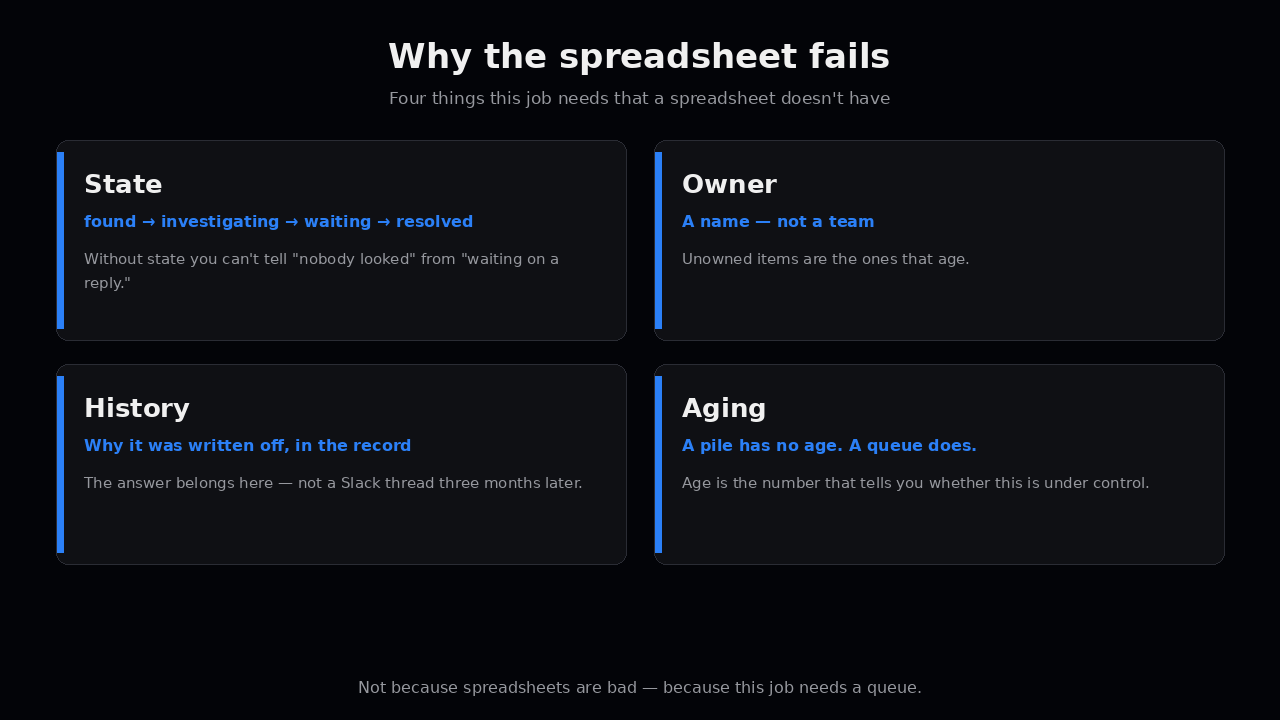
Not because spreadsheets are bad. Because this particular job needs four things a spreadsheet doesn’t have.
State. A spreadsheet row is either there or deleted. An exception has a lifecycle: found, being investigated, waiting on the provider, resolved. Without state you can’t tell “nobody has looked at this” from “we’re waiting on a reply.”
An owner. Not a team. A name. Unowned items are the ones that age.
History. In three months someone will ask why that item was written off. The answer belongs in the record, not a Slack thread.
Aging. A pile has no age. A queue does, and age is the number that tells you whether this is under control.
The structured version
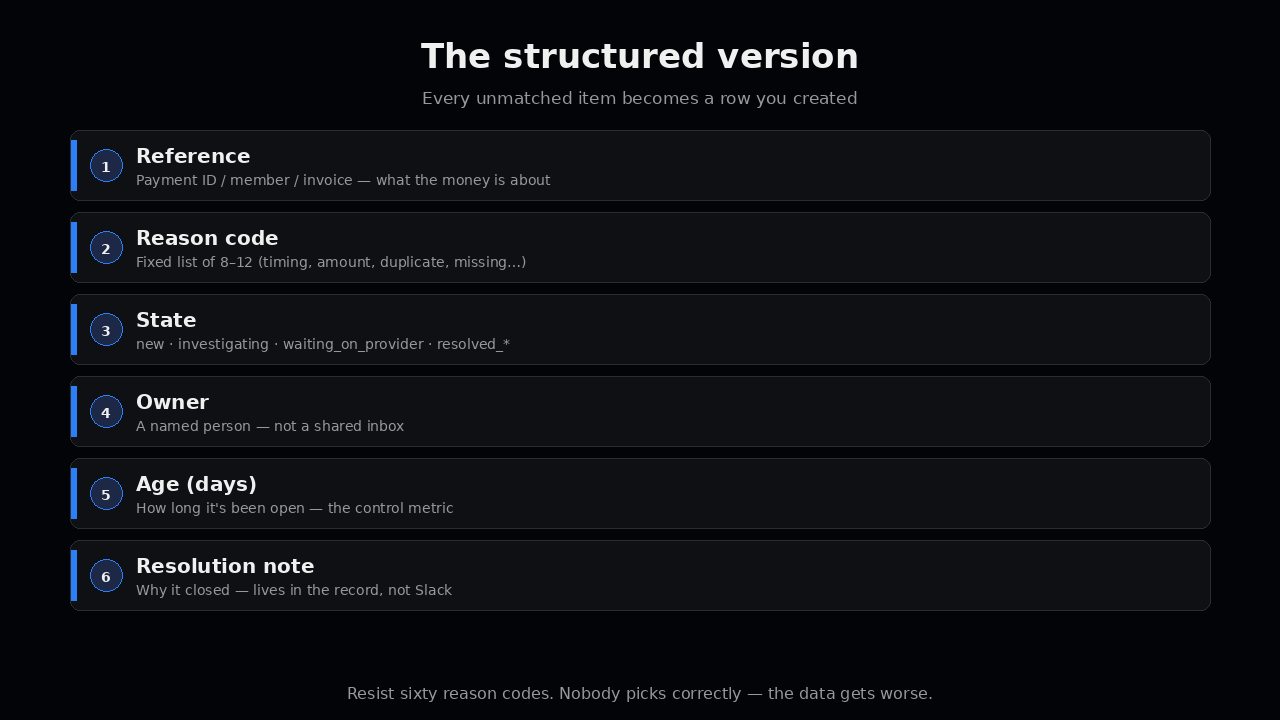
The move is small and mostly unglamorous. Every unmatched item becomes a row you created, with:
- Your own reference — the payment ID, member, invoice, whatever the money is actually about
- A reason code from a fixed list
- A state:
new,investigating,waiting_on_provider,resolved_matched,resolved_written_off - An owner
- The age in days
- A resolution note when it closes
Keep the reason codes short — eight to twelve. Timing difference, amount mismatch, duplicate payment, missing on provider side, missing on platform side, return not applied, fee difference, rounding, unknown. Resist sixty codes. Nobody picks correctly from sixty, and the data gets worse, not better.
Measure two things
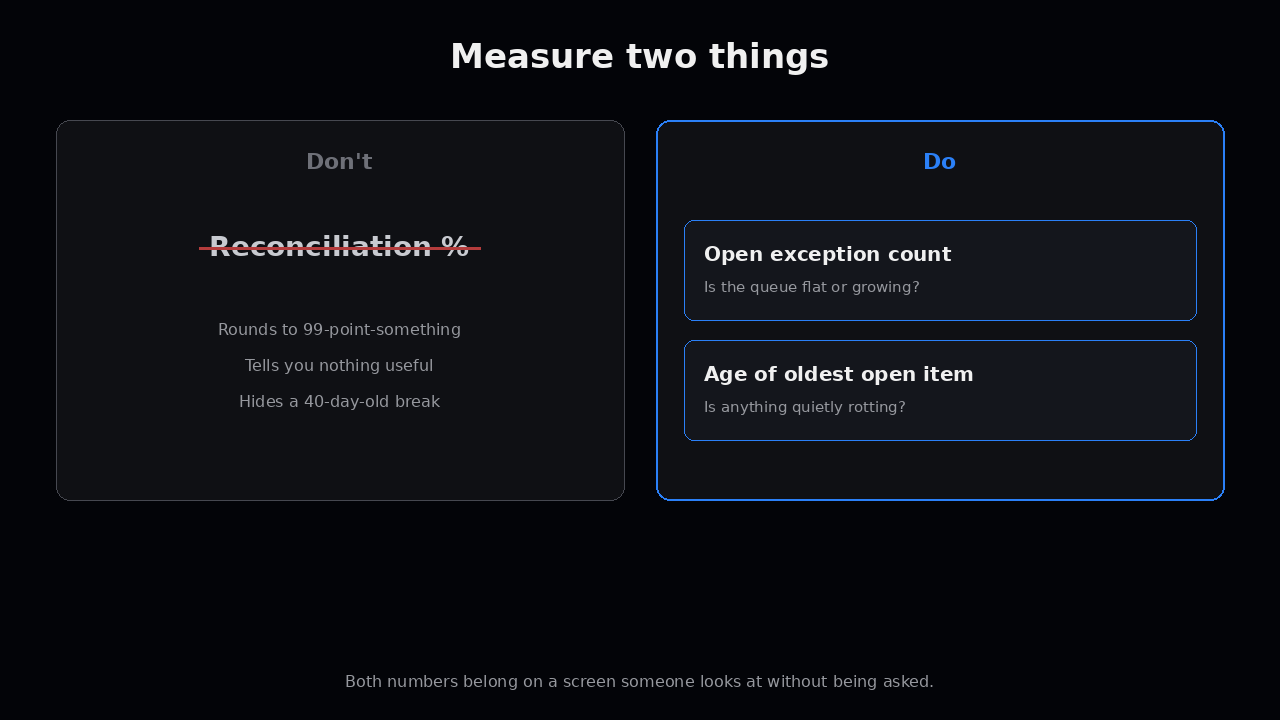
Not “reconciliation rate.” It rounds to 99-point-something and tells you nothing.
Measure open exception count and age of the oldest open item. If the count is flat and nothing is older than a few days, the process is healthy even when the count isn’t zero. If the oldest item is 40 days old, you have a problem regardless of the percentage. Both numbers belong on a screen someone looks at without being asked.
Somebody owns this after go-live
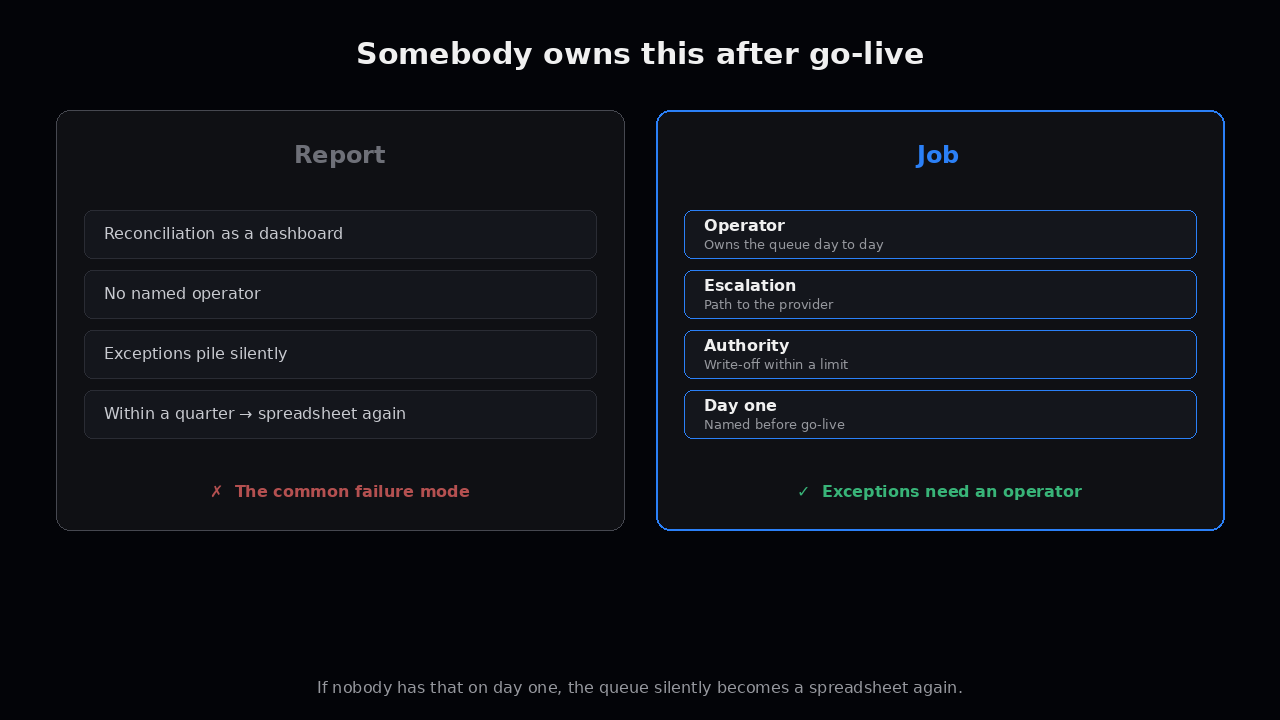
The failure mode we see most isn’t bad software. It’s a system that went live with reconciliation as a report instead of a job. Exceptions need an operator — someone whose actual responsibility is working that queue, with an escalation path to the provider and the authority to write things off within a limit.
If nobody has that on day one, the queue silently becomes a spreadsheet again within a quarter.
What a good Friday looks like
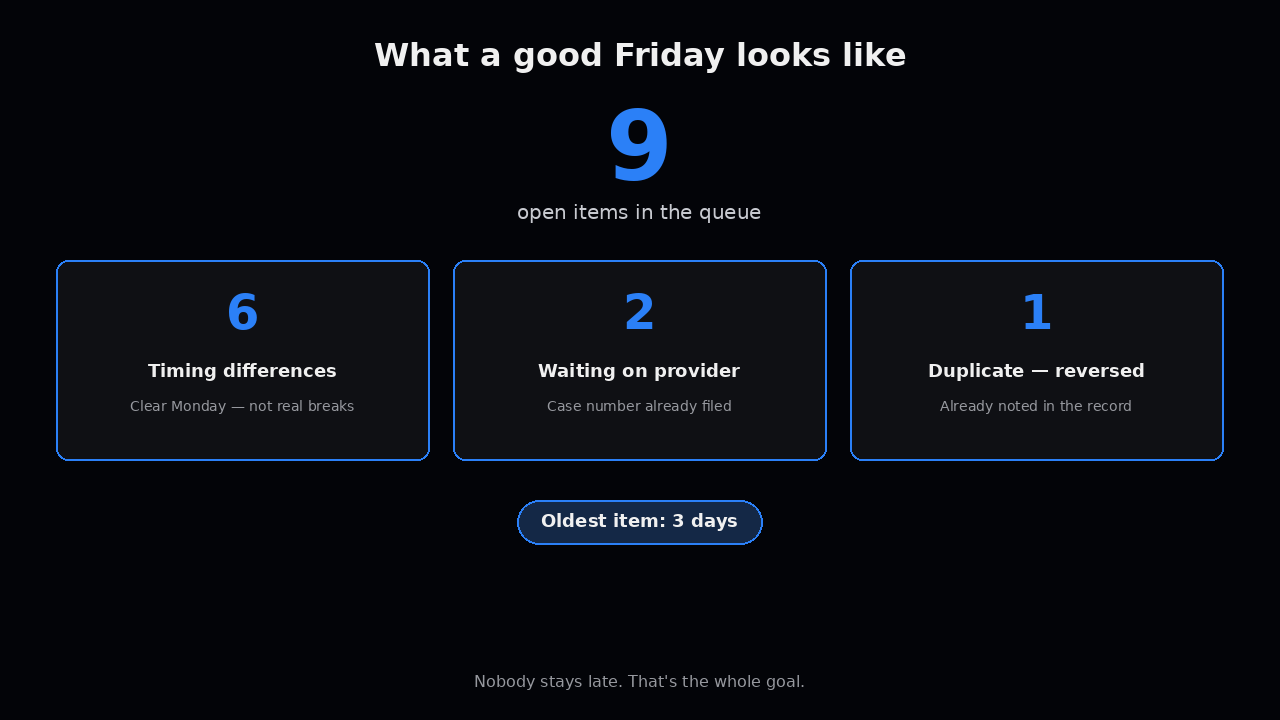
The queue has nine items. Six are timing differences that clear Monday. Two are waiting on the provider with a case number. One is a real duplicate that’s already reversed and noted. The oldest is three days old.
Nobody stays late. That’s the whole goal.
Boundary
Futurify builds software. We don’t hold funds and we’re not a processor. We build the ledger, matching, and exceptions queue — and under Run, we operate that queue with you after go-live.
Next step
Do this part first — it takes two minutes and it’s worth doing whether or not you ever talk to us.
Open last Friday’s spreadsheet. Write down how many rows are on it, and the date on the oldest one. Those two numbers are your baseline. Most teams have never written them down, and watching them across a few weeks tells you more than any reconciliation percentage will.
If you want a second opinion on what they mean, send them to hello@futurify.io. We’ll tell you which of the two matching passes above would clear most of your volume, and what we’d look at first.
If that turns into a longer conversation, good — that’s what we do. If it doesn’t, you still have your baseline.