.png)
File drops are a habit, not an operating model.
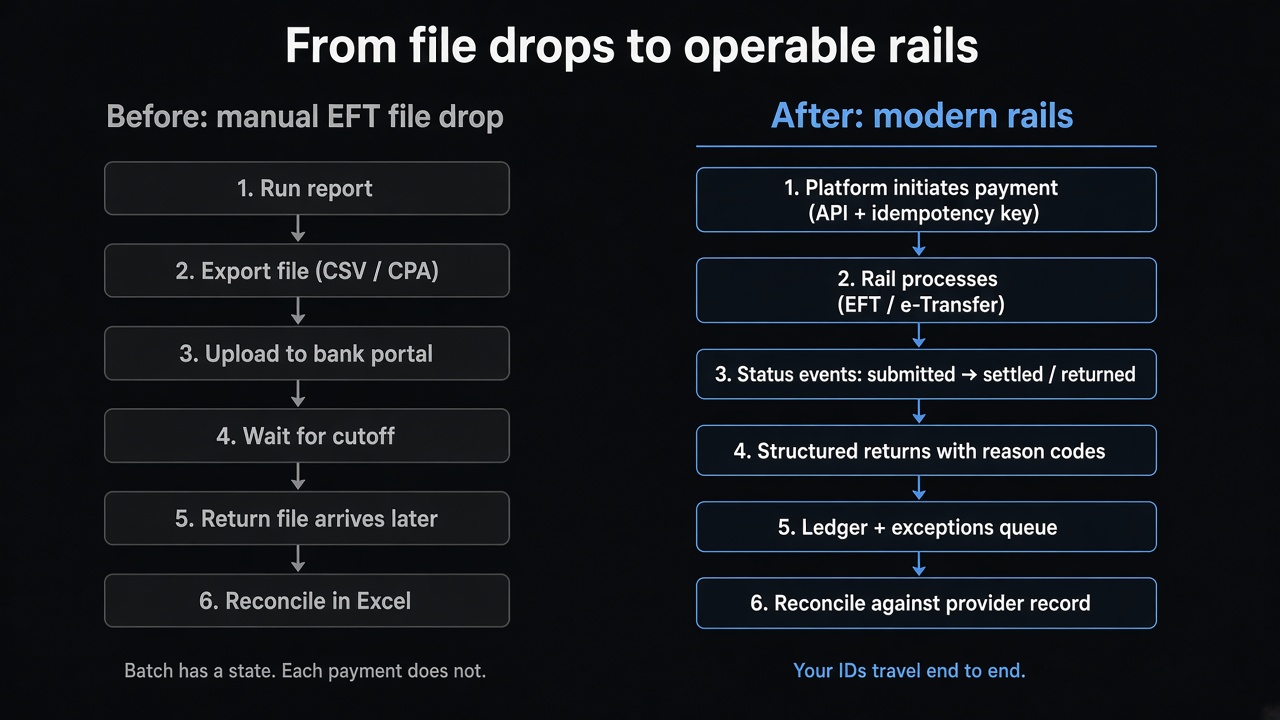
Most Canadian platforms that move money still do it the same way. Someone runs a report. The report becomes a file. The file gets uploaded to a bank portal before the afternoon cutoff. A day or two later a second file comes back with returns in it, and someone opens both in Excel to figure out who actually got paid.
It works. That’s the problem. It works well enough that nobody funds fixing it until something breaks in front of a customer.
What the file drop is really costing you
Not the upload. The upload takes four minutes. The cost is everything the file can’t tell you.
No state per payment. A file has a state: sent, or not sent. The individual payment inside it doesn’t. So when a member calls and asks where their money is, you’re reading a spreadsheet, not a record.
Returns arrive as a surprise. The return comes back days later as a code in another file. By then the platform has already told the user the payment succeeded. Now you’re reversing something downstream that you already counted as done.
A person is the retry logic. If the upload fails halfway, or someone uploads the same batch twice, nothing in the system stops it. The control is that Dana is careful. Dana is careful. Dana also takes vacation.
You can’t reconcile without the one person who remembers. The join between your ledger and the bank’s file lives in someone’s head, along with the six exceptions that are “always like that.”
Audit is a folder. When someone asks you to prove a payment, the evidence is a CSV in Downloads.
None of that shows up as a line item. It shows up as support escalations, slow month-ends, and cutovers you can’t defend.
What “modern rails” actually means here
Skip the marketing version. Concretely, moving off file uploads means four things:
- Payments get initiated over an API, one at a time or in batches you control, with an idempotency key so a retry can’t create a second payment.
- Status comes back as events, not as a file you go looking for. Submitted, settled, returned — each with a timestamp you can show a customer.
- Returns and rejects arrive as structured data with a reason code your system can route, instead of a code someone looks up in a PDF.
- Your own identifiers travel end to end, so the money that comes back can be matched to the member, invoice, or account it belongs to without a human guess.
In Canada that usually means API-initiated EFT for the bulk of volume, with e-Transfer for the edge cases where you need speed or don’t have account details. The Real-Time Rail will change the timing story eventually. It doesn’t change any of the four points above — you want those regardless of which rail you’re on.
The part people underbuild
The integration is the easy half. The half that decides whether this works is the ledger and the exceptions queue.
You need insert-only double entry for movements that affect cash, posted once per idempotency key. You need unmatched items to be a queue with a state, a reason, and a named owner — not a tab someone opens on Friday. And you need reconciliation against the provider’s record, not against your own optimism.
If you build the API integration and skip that, you’ve made the file drop faster. You haven’t made it operable.
Migrating without a bad weekend
Don’t flip everything. Pick one payment type, run it on the new rail alongside the old process, and compare the two settlement views daily until they agree for a full cycle. Then move the next slice. The cutover risk in these projects is almost never the API. It’s the window where both the old rail and the new one are producing settlement records and nobody owns the join.
We’ve done this at production volume. One benefits platform moved off manual EFT uploads onto Zum Rails and now runs about $1M a month through it, reconciled per member against the provider record.
Boundary
Futurify is an ISV. We don’t hold funds and we’re not your processor. You keep your provider agreements. We build and run the software layer that sits between your platform and the rail.
Next step
Tell us the payment type you’d move first and the date it has to land. If you have one real unmatched settlement from last month, bring it. That shortens scoping more than a discovery call does.