.png)
Primer, Spreedly, and Gr4vy are real products. Teams look at them for multi-PSP routing, less hard-wiring, and faster card experiments.
This page is for a different buyer. You want the payment layer inside your perimeter. You want to keep the processor contracts. You have a cutover date.
We are not a drop-in clone of those products. We are an independent software vendor. We build and run a client-owned payment layer. We are not a PSP. We never sit in the flow of funds.
Comparison
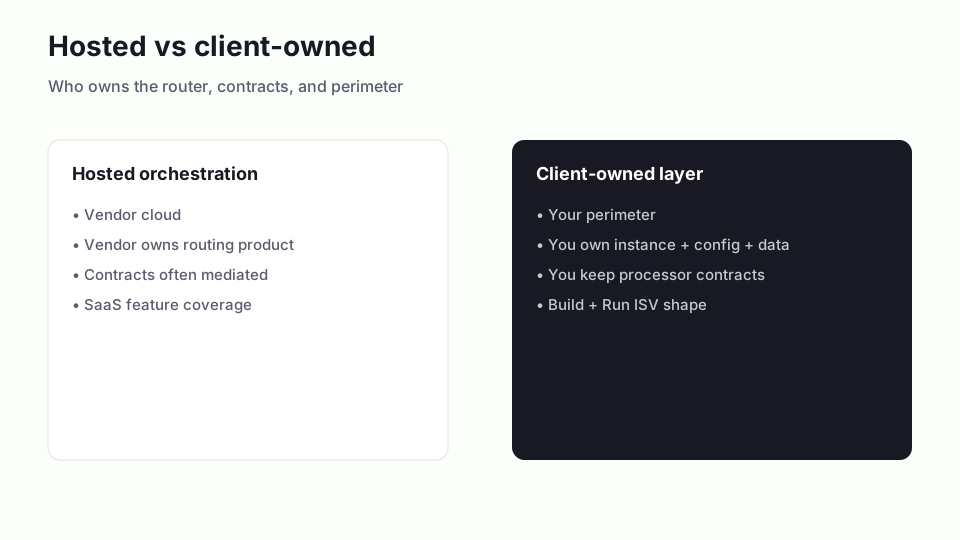
| Hosted orchestration (typical Primer / Spreedly / Gr4vy shape) | Client-owned layer (Futurify) | |
|---|---|---|
| What you buy | Multi-tenant SaaS | Software plus delivery: Build, then Run |
| Where it runs | Vendor cloud (typical) | Your perimeter (default) |
| Who owns the instance | Vendor product | You: instance, config, data, event log |
| Processor contracts | Often through or beside their model | You keep them |
| Flow of funds | Depends on product and setup | Never us. Funds stay with your providers |
| Best at | Card routing, unified APIs, SaaS features | Dated migrations, ledger, reconciliation, ownership constraints |
| Pricing | SaaS / platform fees (their list) | Fixed-price Build + monthly Run per account |
| Second processor | Their roadmap | Wired into every build |
| Banks / credit unions | Often harder | Same layer, inside the institution |
Vendor products change. The left column is the usual category shape, not a line-by-line SKU audit. Check their current docs before you buy.
What hosted orchestrators do well
They get you to multi-PSP card routing without hiring a full payments team. Connectors, dashboards, product cadence. If that is the job, start there.
They also fit when security and procurement already accept a payments SaaS in the path.
When the job is different
Three things show up on platform cutovers:
- Ownership. The software has to run under your controls. Your data residency. Your exit path.
- Contracts and margin. You keep the processor agreement and the spread. The layer should not become a second choke point on the money.
- Reconciliation and cutover. You need a migration that does not break the platform. A settlement view when tickets arrive. A second processor without another greenfield.
If those three matter most, a client-owned layer fits better than another hosted router. Even when the hosted product is good at card orchestration.
What we sell
We build and run the payment layer inside your platform. You keep the processor contract, the spread, and the code.
- Build — fixed price, milestone invoiced
- Run — monthly fee per account (ask for the current ladder)
- Partner disclosure — if a processor pays us a referral or integrator credit, you hear it first
We are not a PSP, payfac, or holder of funds. Never in the flow of funds. Second processor is designed in.
Proof
We have built money-movement systems for payment companies themselves. That includes a multi-year delivery relationship with Nuvei. That supports delivery history. It does not make us a processor.
We do not put unverified portfolio totals on this page. We do not invent competitor weaknesses. If we cannot source a claim, it does not ship.
Who should shortlist what
Shortlist Primer / Spreedly / Gr4vy (or peers) when:
- Card multi-PSP routing is the main problem
- SaaS clears security and procurement
- You want productised orchestration more than you want to own the instance
Shortlist Futurify when:
- You have a cutover date and a processor you are leaving
- The layer must run in your perimeter
- You keep processor contracts and margin
- Ledger, reconciliation, and exceptions with an owner are part of the job
- A second processor must be possible without another discovery project
Tell us what you are integrating and the date it has to land. If a hosted orchestrator is a better fit, we will say so.