
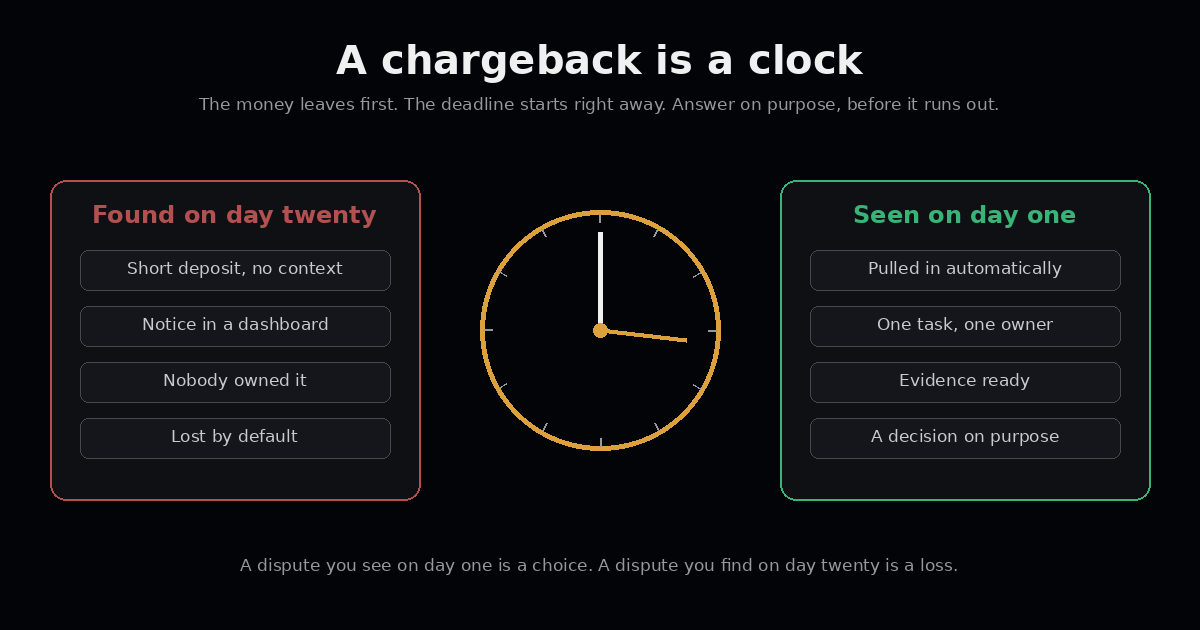
Most teams find out about their first chargeback the same way.
Someone in finance notices the deposit is short. They dig. There’s a line item they don’t recognize. It’s a dispute from three weeks ago, and the window to answer it closed yesterday.
The money is gone. Not because the customer was right. Because nobody answered.
The money leaves first
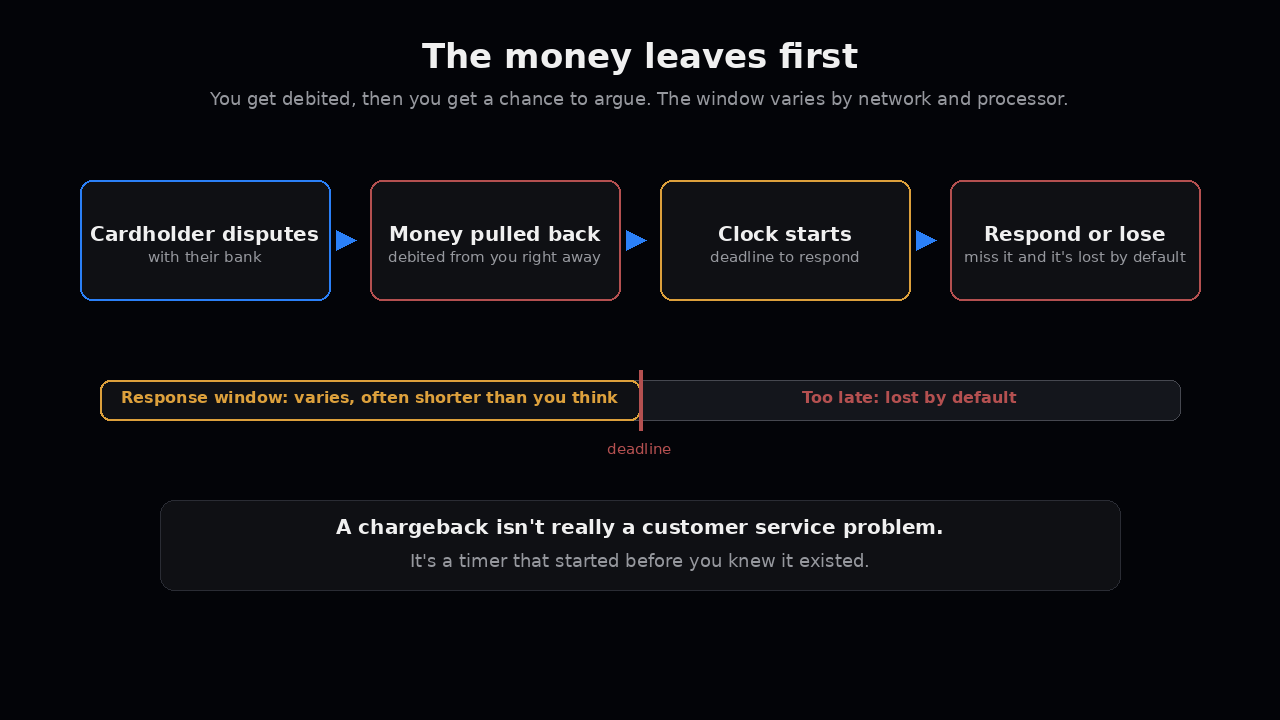
Here’s the part that surprises people. When a cardholder disputes a charge, the processor usually pulls the money back from you right away. You don’t get a hearing first. You get debited, then you get a chance to argue.
And that chance has a deadline. It’s set by the card network and your processor, it varies, and it’s often shorter than you’d guess. Miss it and the dispute is lost by default, no matter how good your proof was.
So a chargeback isn’t really a customer service problem. It’s a timer that started before you knew it existed.
Why disputes slip through
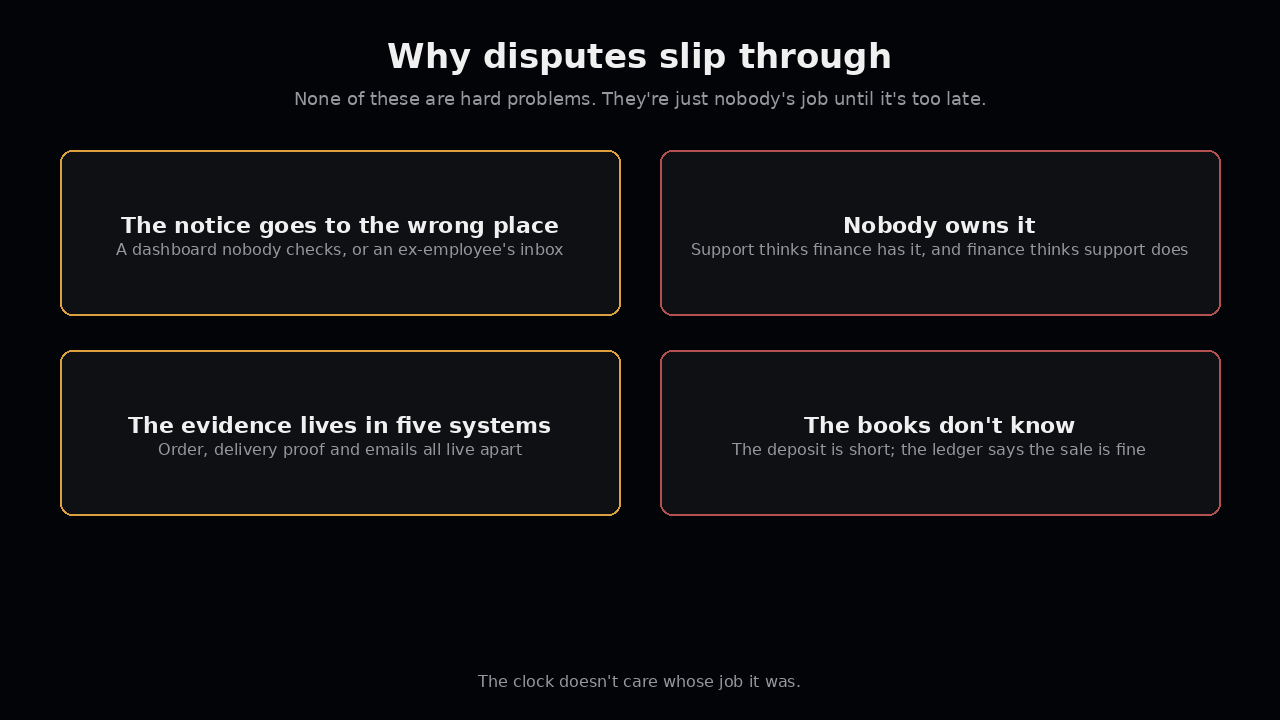
We see the same few gaps again and again:
- The notice goes to the wrong place. It lands in a processor dashboard nobody logs into, or an email inbox owned by someone who left.
- Nobody owns it. Support thinks finance has it. Finance thinks support has it. The clock doesn’t care.
- The evidence lives in five systems. The order is in one place, the delivery proof in another, the customer emails in a third. Pulling it together takes days you don’t have.
- The books don’t know. The dispute debit shows up in the deposit, but the ledger still says the sale is fine. Now reconciliation is off and nobody knows why.
None of these are hard problems. They’re just nobody’s job until it’s too late.
Treat it like a task with a due date
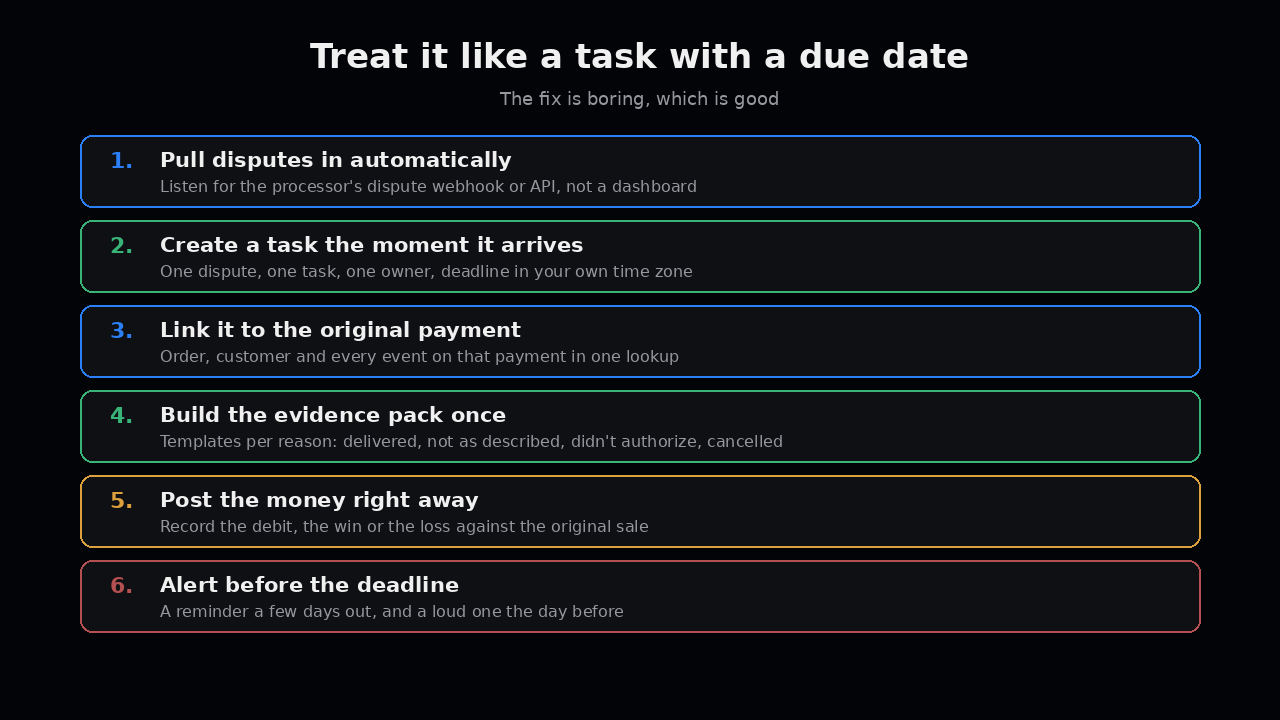
The fix is boring, which is good.
- Pull disputes in automatically. Most processors send a webhook or have an API for disputes. Listen for it. Don’t rely on someone checking a dashboard.
- Create a task the moment it arrives. One dispute, one task, one owner, and the deadline written on it in your own time zone.
- Link it to the original payment. The task should open straight to the order, the customer, and every event on that payment. If you used your own id from the start, this is one lookup, not an investigation.
- Build the evidence pack once. Decide what proof you send for each common reason: delivered, not as described, didn’t authorize, cancelled. Template it. Fill it from your own data.
- Post the money right away. When the dispute debit lands, record it against the original sale. When you win or lose, record that too. Your books should never be surprised by a deposit.
- Alert before the deadline, not after. A reminder a few days out, and a loud one the day before.
Not every dispute is worth fighting
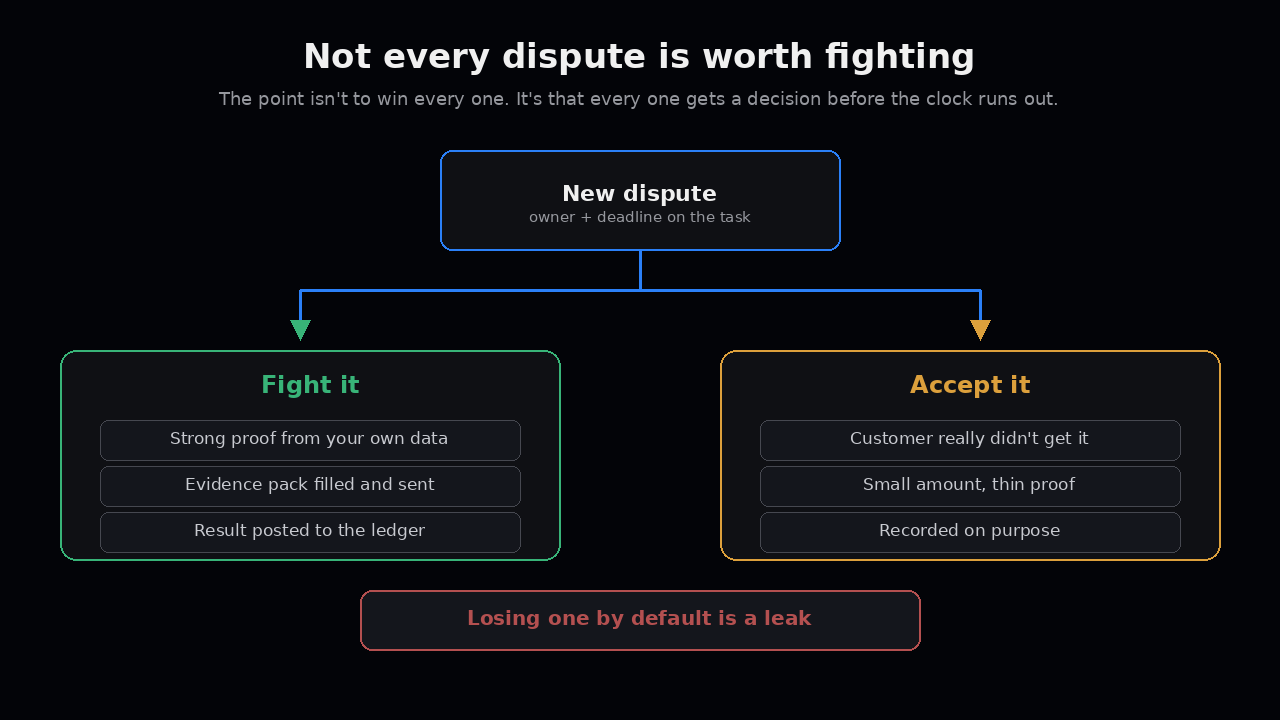
Some disputes you should just accept. The customer really didn’t get the thing. The amount is small and the proof is thin. Fighting it costs more time than it’s worth.
That’s fine. The point isn’t to win every one. The point is that every one gets a decision, on purpose, before the clock runs out. Accepting a dispute is a choice. Losing one by default is a leak.
Watch the rate, not just the case
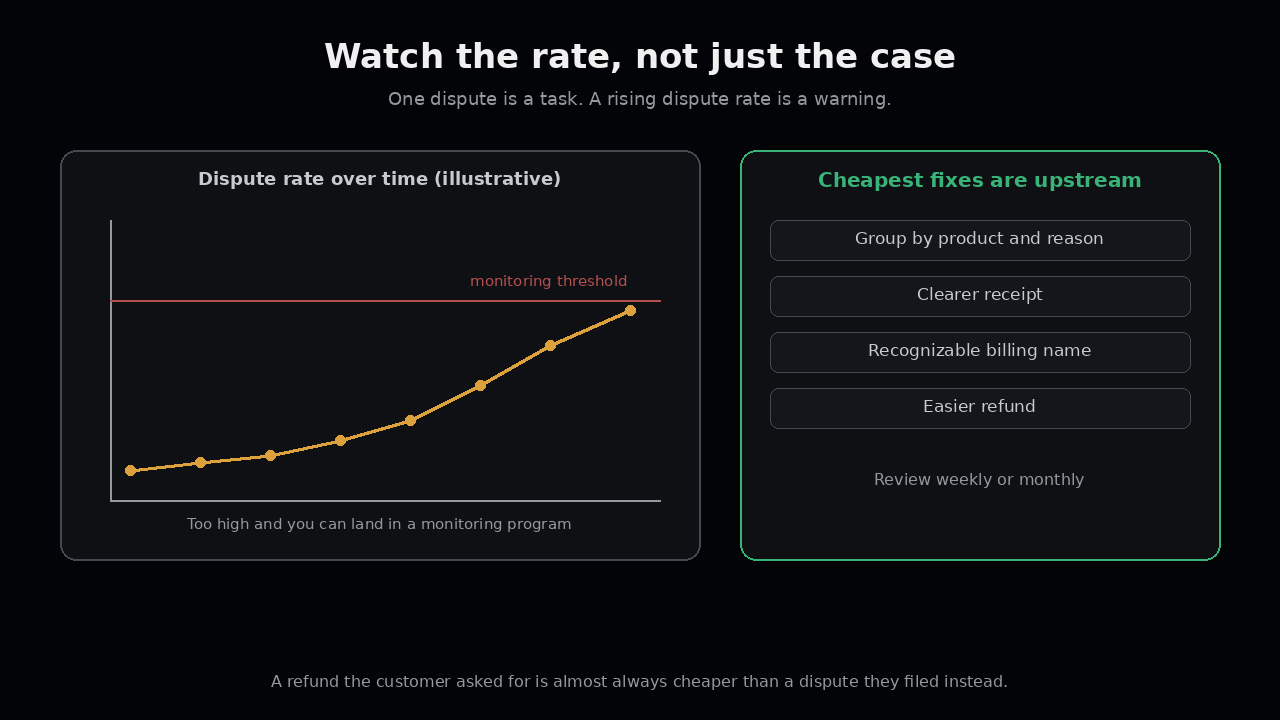
One dispute is a task. A rising dispute rate is a warning. Card networks and processors watch your rate, and if it climbs too high you can end up in a monitoring program, with extra fees or worse.
So look at disputes as a group every week or month. Which products? Which reasons? Is a confusing descriptor on the card statement making people think they were never charged? Often the cheapest fix is upstream: a clearer receipt, a better billing name, an easier refund.
A refund the customer asked for is almost always cheaper than a dispute they filed instead.
What to check this week
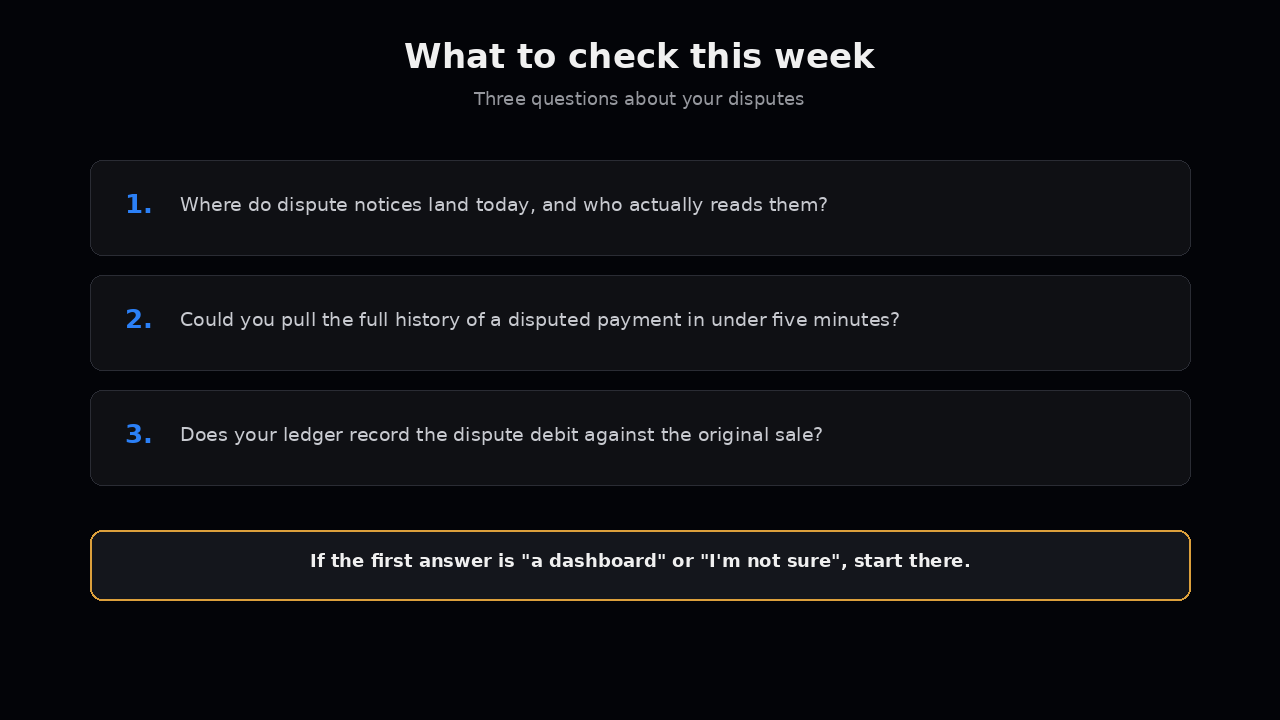
- Where do dispute notices land today, and who actually reads them?
- Could you pull the full history of a disputed payment in under five minutes?
- Does your ledger record the dispute debit against the original sale, or does it just show up as a short deposit?
If the first answer is “a dashboard” or “I’m not sure”, start there. A dispute you see on day one is a choice. A dispute you find on day twenty is a loss.
Futurify builds the software around your payments: the queues, the states, and the paper trail that make disputes a routine task instead of a surprise. We don’t hold funds. If you want to talk it through, email us at hello@futurify.io.